
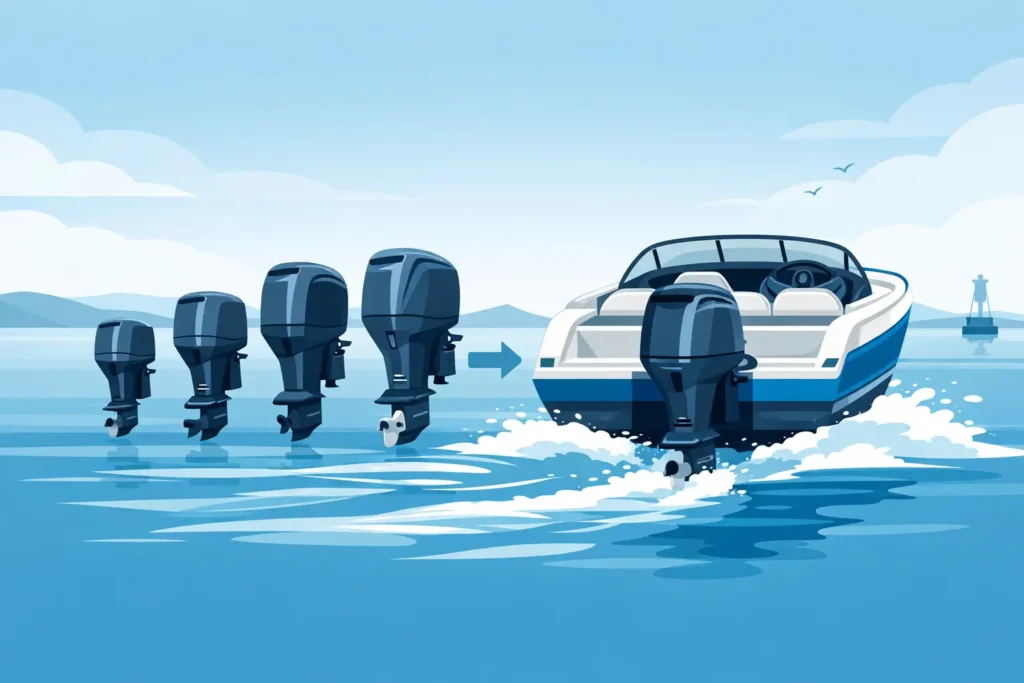
You feel it right away when the motor is wrong for the boat. Too little horsepower and the boat struggles to plane, burns more fuel under load, and feels lazy with a full crew. Too much horsepower and you are dealing with cost, extra weight, and a setup that may go beyond the hull rating. If you are asking what horsepower outboard do I need, the right answer comes down to the boat’s max rating, total load, hull type, and how you actually use the boat.
This is not a guess-and-go purchase. Horsepower affects hole shot, cruise speed, fuel economy, top-end performance, and even how the boat balances at the transom. If you are shopping for a replacement or moving up in power, getting this part right saves money and avoids buying twice.
Start with the boat’s horsepower rating
The first number that matters is not the one on the engine cowl. It is the maximum horsepower listed on the boat’s capacity plate or in the manufacturer specs. That rating is your hard ceiling. If the hull is rated for 150 HP, that is the limit. Going over it is a bad idea for safety, insurance, and resale.
For many buyers, the real decision is not whether to max out the rating, but whether to run at the low end, the middle, or the top of the approved range. A lightly used skiff that sees one or two passengers on calm water may perform fine below max horsepower. A center console carrying family, gear, fuel, a livewell, and ice most weekends usually benefits from more power, not less.
There is a simple rule that helps here. If your boat is regularly loaded heavy, used offshore, or expected to jump on plane quickly, buy closer to the top of the rated horsepower range. If your use is light and your priority is initial cost over speed, a lower horsepower option may still make sense.
What horsepower outboard do I need for my boat type?
Boat type changes everything. Two boats with the same length can need very different power because hull design, weight, and intended use are not the same.
Aluminum fishing boats and small tiller boats
These usually do not need extreme horsepower to perform well. A 14- to 16-foot aluminum boat may run great with 20 to 50 HP depending on hull weight and load. Going too small can still be a mistake if you fish with multiple people, carry batteries, tackle, and a trolling motor, or run in current.
Bass boats
Bass boats are built for speed and quick planing. They often perform best closer to their rated max horsepower. A bass boat with too little motor will still float and run, but it will not deliver the performance buyers expect.
Pontoon boats
Pontoon buyers often underestimate horsepower. A small pontoon used for slow cruising on a lake can get by with lower power. But once you add a larger crew, tow tubes, or expect decent midrange speed, horsepower becomes more important fast. A 115 HP, 150 HP, or even 200 HP setup is common depending on size and use.
Center consoles and bay boats
These boats often carry more fuel, more passengers, and more gear. They also tend to be used in rougher water where staying on plane matters. This is where underpowering really shows up. In many cases, 150 HP to 250 HP is the practical shopping range, especially if the boat is in the 19- to 24-foot class.
Work boats and commercial use
If the boat is used for guide work, patrol, transport, or regular heavy-duty use, horsepower should be chosen with load and reliability in mind, not just sticker price. Running a smaller engine wide open all the time is not a bargain if it shortens engine life and raises fuel burn.
Weight matters more than many buyers think
A boat’s dry weight is only the starting point. Real-world weight includes fuel, batteries, gear, coolers, safety equipment, passengers, and any add-ons. That extra weight is often why a boat that looked fine on paper feels underpowered on the water.
If you are replacing an outboard and the old setup always felt slow to plane, struggled with a full load, or forced you to run hard just to cruise, treat that as useful evidence. The boat may need more horsepower within its rated limit, or it may need a better-matched prop and engine setup. But if you are already shopping for a motor, this is the time to fix the problem.
As a rough practical guide, lightweight boats with light loads can live happily in the lower or middle of the rated range. Heavier fiberglass hulls, offshore use, and regular full-load operation usually justify the upper end.
Performance goals change the answer
When buyers ask what horsepower outboard do I need, they are often really asking what kind of performance they want to pay for.
If your goal is simple cruising, short trips, and solid reliability, you may not need the biggest motor approved for the hull. If your goal is fast planing, better top speed, easier towing, or keeping cruise RPM lower under load, more horsepower has a real payoff.
There is also a value angle here. A bigger motor costs more upfront, but the cheapest engine is not always the best buy. An underpowered setup can feel disappointing from day one. On the other hand, paying for horsepower you will never use may not make sense either, especially for casual lake use.
The best buyers stay honest about their real use. If you fish alone on inland water, your needs are different from a family running a loaded center console every weekend. If you are repowering for resale, many boats are easier to sell when they are powered near the top of their rating range.
Common horsepower ranges buyers compare
This is where many practical buying decisions happen. Certain horsepower classes fit common boat sizes and uses, and they come up again and again.
A 115 HP outboard is a strong option for smaller pontoons, aluminum boats, bay boats, and some lighter center consoles. It gives a clear step up from lower horsepower models without jumping into larger-engine cost.
A 150 HP outboard is one of the most versatile classes on the market. It is often the sweet spot for many 18- to 21-foot boats because it balances price, performance, and fuel use well.
A 175 HP or 200 HP outboard makes sense when the boat is heavier, the load is more demanding, or the owner wants stronger acceleration and better offshore confidence. These are common upgrade points for buyers who regretted going too small the first time.
A 225 HP or 250 HP outboard is usually where larger center consoles, bay boats, and higher-performance applications live. At this level, transom weight, boat setup, and intended load matter even more. The gain in performance can be significant, but so is the jump in purchase price.
New vs used can affect your horsepower choice
Budget matters. For many buyers, the question is not just what horsepower fits the boat, but what horsepower fits the budget right now.
That is where comparing new and used inventory can open up better options. Instead of settling for less horsepower than the boat really wants, some buyers can move into a higher class by considering a quality used outboard. That can be a smarter play than buying a smaller new motor that leaves the boat underpowered.
The same logic applies across brands and model years. The best deal is not only the lowest listed number. It is the engine that gives your boat the right performance at a price that makes sense. Yamaha Motor Shop focuses on exactly that kind of buying decision, especially for shoppers comparing horsepower, availability, and budget side by side.
Do not ignore engine weight and setup
Horsepower is not the whole story. Engine weight at the transom matters, especially on smaller boats. A modern four-stroke may weigh more than an older two-stroke with similar horsepower. In some repowers, that extra transom weight can affect draft, balance, and performance.
Rigging also matters. Shaft length, prop selection, mounting height, and steering setup all affect how the boat runs. A correctly matched 150 HP can outperform a poorly set up 175 HP in real use. If you are replacing an existing outboard, compare the old engine weight and transom setup before choosing purely on horsepower.
A simple way to decide
If you want the shortest path to the right answer, start with the max horsepower rating. Then look at your normal load, your boat type, and your performance goal. If you run light and easy, stay in the middle of the approved range. If you run heavy, carry people, tow, or fish bigger water, shop closer to the top of the range.
If you are between two horsepower classes, ask yourself one question: have you ever heard a boat owner complain about needing less performance? It happens far less often than buyer regret from going too small. Still, the right move is not always the biggest motor. It is the motor that fits the hull, the load, and the job without wasting money.
A good outboard match should feel easy. The boat planes without drama, cruises comfortably without pushing hard, and carries your normal load without excuses. That is the number you want to buy.