
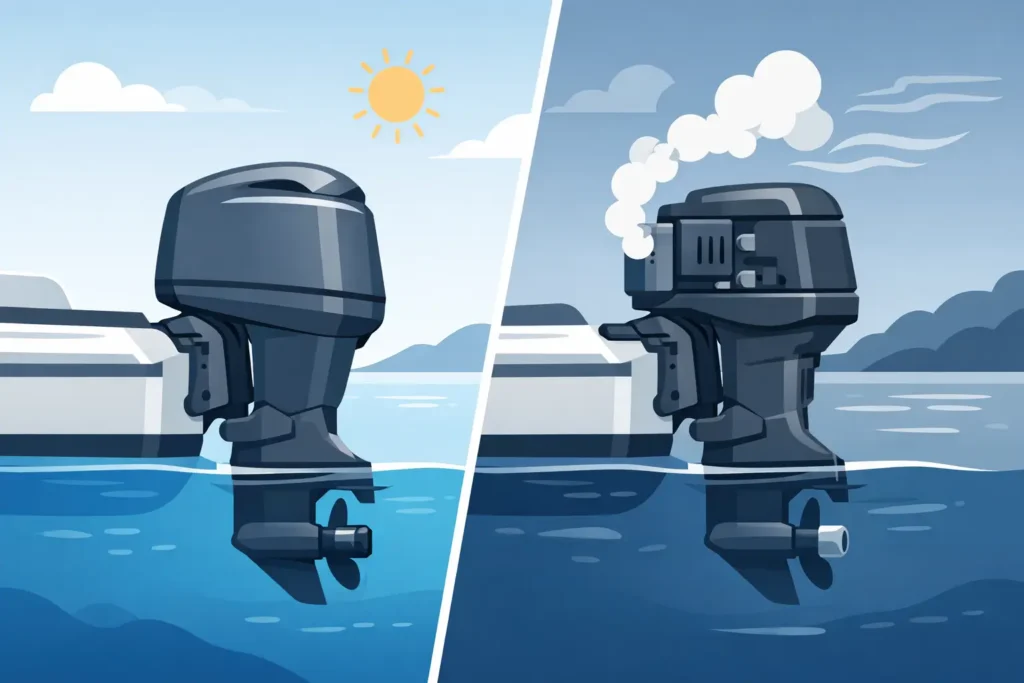
If you are shopping for power and trying to sort out 4 stroke vs 2 stroke outboard options, the real question is not which one is better on paper. It is which one makes more sense for your boat, your workload, and your budget. A flats boat used every weekend, a center console rigged for offshore runs, and a small commercial skiff do not ask the same thing from an engine.
For most buyers in today’s market, the answer leans toward 4-stroke power because it delivers better fuel economy, cleaner operation, and easier long-term ownership. But that does not mean 2-stroke outboards are obsolete or a bad buy. In some setups, especially where weight and punch matter most, they still make a strong case.
4 stroke vs 2 stroke outboard: the core difference
A 4-stroke outboard completes its power cycle in four piston strokes and keeps oil and fuel separate. A 2-stroke outboard completes that cycle in two strokes and traditionally mixes oil with fuel or uses an oil injection system. That design difference affects almost everything that matters to a buyer – fuel burn, weight, sound, emissions, maintenance style, and overall feel on the water.
The old rule was simple. Two-strokes were lighter, louder, and stronger out of the hole. Four-strokes were heavier, smoother, and more efficient. That rule still helps, but modern engines have narrowed the gap in some areas, so buyers should look at actual use rather than relying on outdated assumptions.
Why most buyers now choose 4-stroke outboards
If you are buying a newer replacement engine in the 115 HP to 250 HP range, 4-stroke models usually dominate the conversation. There is a reason for that. They fit how most US boat owners use their boats today.
Fuel efficiency is a big factor. If you make long runs, troll for extended periods, or simply want to spend less at the pump over time, a 4-stroke outboard usually gives you an advantage. That matters even more when fuel prices jump or when your boat sees regular use instead of occasional weekend trips.
Noise is another factor buyers notice right away. A modern 4-stroke tends to idle quieter and run smoother across a wider RPM range. If you spend full days on the water, that lower vibration and cleaner sound are not small details. They change the ownership experience.
Then there is resale. In many segments of the used market, 4-stroke outboards are easier to move because more buyers want them. That does not guarantee higher value in every case, but it often makes a newer 4-stroke a safer buy if you plan to sell or repower again down the line.
Where 2-stroke outboards still make sense
A 2-stroke outboard still has real advantages, especially for buyers who care about low weight and sharp throttle response. On smaller boats, transom weight matters. Less weight at the stern can improve balance, hole shot, and shallow-water performance.
That quick, aggressive power delivery is the reason many experienced boaters still like 2-strokes. If your boat needs to jump on plane fast or you run in conditions where instant response matters, a 2-stroke can feel more lively. Some commercial operators also value the simplicity of older 2-stroke platforms, especially if they already know how to maintain them and can source parts without trouble.
Cost can also shift the decision. In used inventory, a 2-stroke may offer a lower entry price than a comparable 4-stroke. For a buyer trying to get back on the water without stretching the budget, that can be the deciding factor.
Fuel use and operating cost
For many buyers, this is where the 4 stroke vs 2 stroke outboard decision gets real. Upfront price matters, but so does what the engine costs to run over time.
In general, 4-stroke outboards are more fuel efficient. If you log serious hours, that difference adds up. A buyer who runs offshore, covers long distances, or uses the boat for work may recover part of the higher initial cost through fuel savings.
Two-strokes can cost less to buy, especially on the used side, but they usually burn more fuel and require oil as part of operation. That does not automatically make them more expensive overall. If you use the boat lightly and bought the motor at the right price, the lower purchase cost may still work in your favor.
This is where honest usage matters. A weekend buyer who runs short distances a few times a month has a different cost equation than a guide, crabber, or commercial operator who racks up hours fast.
Maintenance and service reality
A lot of buyers assume one engine type is simply easier to own. The truth is more practical than that.
A 4-stroke outboard has routine service needs similar to other four-stroke engines. Oil changes, filters, scheduled inspections, and regular maintenance matter. The upside is that service intervals and maintenance expectations are familiar to most owners and technicians.
A 2-stroke avoids crankcase oil changes, but that does not mean no maintenance. You still need to watch fuel system health, oil delivery where applicable, plugs, cooling, and overall wear. Older 2-strokes can be straightforward to work on, but age changes the equation. Parts availability, corrosion, and previous owner care matter as much as engine design.
For buyers who want predictable ownership and broad service support, a newer 4-stroke usually feels like the safer lane. For buyers comfortable with older platforms and hands-on upkeep, a 2-stroke can still be a practical value.
Weight, performance, and boat fit
Boat fit matters more than engine debates online. A heavy engine on the wrong hull can create problems that no spec sheet fixes.
Two-strokes are often lighter for comparable horsepower, particularly older models. That can help small skiffs, jon boats, and lightweight hulls where stern weight affects trim and handling. If your current setup was built around a lighter engine, switching to a heavier 4-stroke without checking transom capacity and performance expectations can be a mistake.
At the same time, many newer boats are designed with modern 4-stroke outboards in mind. On those hulls, the weight difference may not matter much, and the smoother operation can easily outweigh any small performance trade-off. If you are shopping in common repower ranges like 115 HP, 150 HP, 200 HP, or 250 HP, matching the motor to the hull and load is more important than choosing based on engine type alone.
Emissions and regulations
This part is less exciting, but it affects real buying options. Modern emissions rules pushed the market heavily toward 4-stroke technology, especially in newer outboards sold through mainstream retail channels.
That means if you want a newer engine with easier compliance, broader availability, and fewer restrictions in regulated areas, 4-stroke choices tend to be stronger. Two-strokes still exist in the market, especially used, but buyers should pay attention to age, local regulations, and where the boat will be used.
Which outboard is better for your budget?
If your goal is lowest upfront cost, a used 2-stroke may be the better deal. If your goal is lower fuel burn, quieter operation, and stronger long-term market appeal, a 4-stroke often wins even if the purchase price is higher.
That is why the best buying decision usually comes down to three questions. How many hours will you run each season? How sensitive is your boat to engine weight? And are you buying for short-term value or long-term ownership?
A budget-conscious buyer replacing a failed engine on an older boat may do very well with the right 2-stroke. A buyer repowering a newer center console for family use, fishing trips, or resale value will usually be better served by a 4-stroke. Neither answer is automatic.
The smart way to shop 4 stroke vs 2 stroke outboard options
Start with your hull rating, target horsepower, and actual use. Then compare available inventory, not just ideal specs. A great engine at the wrong weight, wrong shaft length, or wrong price is not a great buy.
It also helps to shop with the total deal in mind – engine condition, warranty situation, model year, and support after the sale. For many buyers, especially in higher horsepower classes, availability matters just as much as theory. If you are comparing in-stock motors and need a fast replacement, practical fit and price should lead the decision.
At Yamaha Motor Shop, this is usually where buyers narrow the field fastest. They already know the horsepower they need. The real job is finding the best-value outboard that fits the transom, the workload, and the budget without wasting time.
If you are still stuck between the two, lean toward the engine that fits how you really boat, not how you imagine you might boat once a year. The right outboard is the one that starts your season with fewer compromises and keeps you moving when the water is not waiting.